Experience and adaptive stealth horror prototype
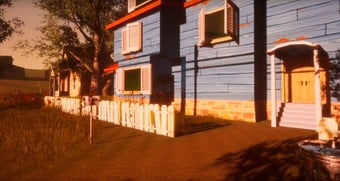
Hello Neighbor Prototype is an early stealth-horror build that tasks players with breaking into a suspicious neighbor's house to solve environmental puzzles and avoid detection while exploring an AI engine that adapts to repeated behaviors. Key features include stealth-based navigation, interactive objects, rudimentary trap placement by the AI, and a tense first-person atmosphere driven by sound.
Top Recommended Alternative

Environmental puzzles and player agency
The prototype centers on an early AI that uses heuristic pathfinding and heatmaps to record player coordinates and place pre-defined traps in high-traffic areas. Gameplay combines stealth navigation, environmental puzzles, and item interaction across the different areas of the neighbor’s house. While the AI learns routes, it does not inhabit complex logic; it simply identifies the player’s frequented entrances and places stative obstacles there. Players search for keys and tools, manipulate objects to open new routes, and rely on sound and line-of-sight to avoid detection.
Player workflows, problem-solving and emergent gameplay
Sessions are short and centered on iterative problem-solving: observe, attempt an entry, learn from failure, and adapt tactics. The sandbox approach supports multiple solutions—windows, vents, tools, and distraction techniques—encouraging experimentation. Because the AI modifies the environment after repeated detection, players develop new strategies and avoid predictable paths.
As an early build, the experience features rough edges and unoptimized performance. The scope is restricted, offering limited content and a brief total playtime, but the AI’s ability to block repeated paths forces the player to innovate and avoid predictable behavior to make the most out of the game.
Navigate the sandbox architecture of emergent gameplay
Hello Neighbor Prototype delivers a concentrated look at the franchise's formative mechanics, spotlighting adaptive AI-driven stealth and puzzle design in a compact package. Its strengths are mechanical clarity, emergent challenges, and a suspenseful atmosphere, though its unpolished presentation and short length reflect its developmental status.